
Some processes require human judgement. Some aren't stable enough. Some aren't worth the investment. Knowing when not to automate is a sign of system maturity.
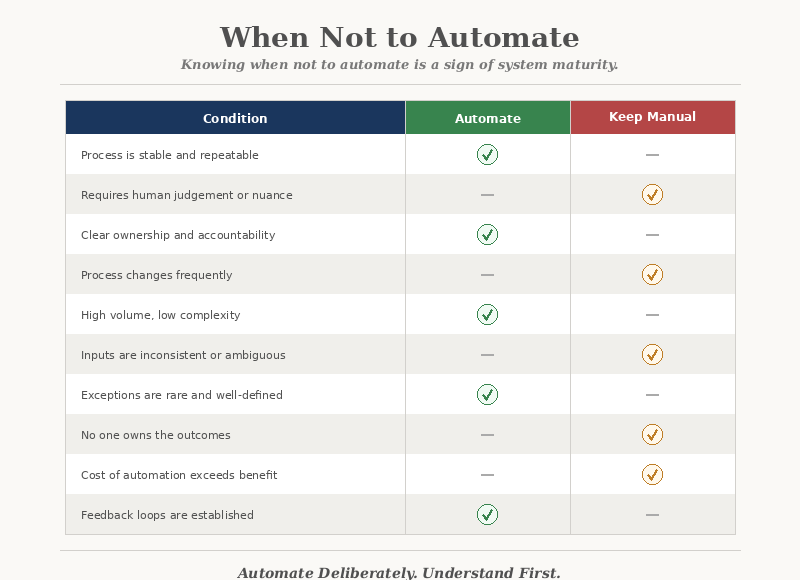
Automation Is a Design Choice, Not a Default
Automation is powerful — but it is not neutral. Once introduced, it:
- Shapes behaviour
- Locks in assumptions
- Increases complexity
- Creates long-term maintenance obligations
This means automation should be treated as a design decision, not an automatic response to inefficiency.
The wrong question:
"Can this be automated?"
The right question:
"Should it be?"
When Human Judgement Is Essential
Some processes depend on context, nuance, and interpretation. These include:
- Sensitive decisions
- Exception handling
- Risk assessment
- Situations involving incomplete or ambiguous information
In these cases, automation can remove discretion, oversimplify reality, and produce outcomes that look correct but feel wrong.
Humans can weigh trade-offs. Systems cannot. Automation should support judgement — not replace it.
When the Process Isn't Stable
Automation assumes consistency. If a process:
- Changes frequently
- Depends on informal decisions
- Varies by context or case
- Has unclear inputs or outputs
Then automation will be fragile.
In unstable processes, exceptions dominate, rules constantly change, and workarounds increase.
When the Cost Exceeds the Benefit
Automation has costs that are often underestimated. Beyond initial development, it requires:
- Ongoing maintenance
- Monitoring and ownership
- Handling of edge cases
- Updates as conditions change
If a process occurs infrequently, has low impact, or requires minimal effort — then automation may offer little real value.
Sometimes the simplest solution is to leave a process manual — but visible and well understood.
When Automation Reduces Learning
Manual processes often surface valuable signals. They reveal:
- Where work is unclear
- Where decisions are difficult
- Where the system needs improvement
Automating too early can hide these signals. Once the system runs automatically, friction disappears, feedback weakens, and learning slows.
In early stages of system design, friction is informative.
When Accountability Becomes Unclear
If no one is clearly responsible for:
- Monitoring outcomes
- Reviewing exceptions
- Adjusting rules
Then automation creates risk. Processes without ownership should not be automated.
Automation without accountability is not efficiency — it is exposure.
Automation Should Follow Understanding
In well-designed systems, automation is applied selectively.
It supports:
- Repetitive, well-defined steps
- Stable workflows
- Clear ownership and feedback loops
It avoids:
- Ambiguous decisions
- Unstable processes
- Areas requiring judgement
This restraint makes automation more effective — not less.
The Role of AI Makes Restraint Even More Important
AI increases the temptation to automate. But AI systems learn from existing patterns, reflect existing biases, and operate probabilistically.
When applied without care, AI can:
- Reinforce flawed processes
- Mask underlying issues
- Create outcomes that are hard to explain or defend
In many cases, the right choice is not to automate — but to observe, understand, and redesign.
Mature Organisations Know What to Leave Manual
High-performing organisations are not fully automated. They are selectively automated.
They know:
- Where systems add value
- Where people add value
- Where clarity matters more than speed
They design for understanding first.
Closing Reflection
Automation is a tool — not a goal.
The most effective systems are not those that automate everything, but those that automate deliberately.
Knowing when not to automate is one of the clearest signs that an organisation understands its own system.
And understanding always comes before automation.