
Automation does not fix broken processes. It accelerates them.
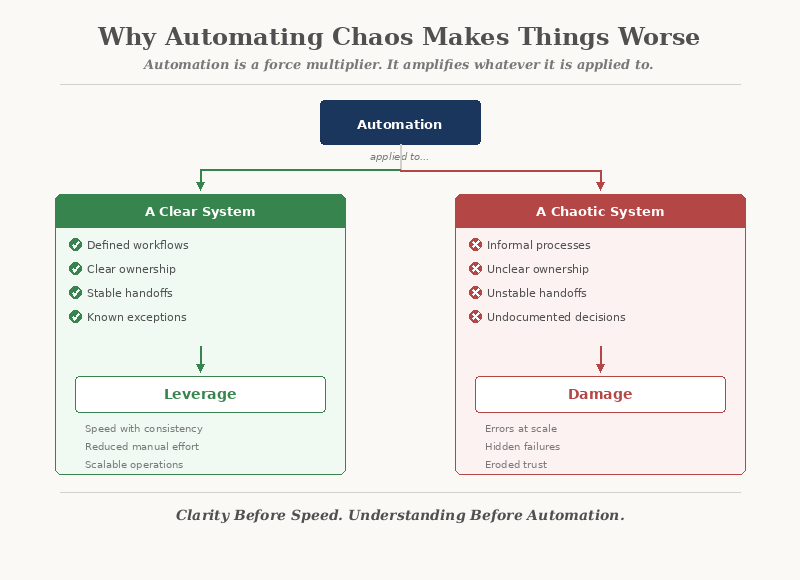
What Automation Actually Does
At its core, automation does one thing well: it removes friction from repetition.
When a process is clear:
- Reduces manual effort
- Improves consistency
- Increases throughput
When a process is unclear:
- Moves errors faster
- Hides problems deeper
- Makes failures harder to trace
The technology behaves exactly as designed. The issue lies in what it is applied to.
Chaos Is Not Random — It's Structural
What many organisations describe as "chaos" is not disorder. It is a system that:
- Evolved informally
- Contains conflicting rules
- Relies on undocumented decisions
- Depends on individual judgement
From the outside, it looks messy. From the inside, people know how to make it work — often through experience and improvisation.
This kind of system functions because humans compensate for its gaps. Automation removes that compensation.
What Breaks When Chaos Is Automated
When an unclear system is automated, several things happen quickly:
Errors scale
Mistakes that once affected a single case now affect hundreds.
Exceptions multiply
Edge cases overwhelm the automated path, forcing manual intervention.
Accountability blurs
When something goes wrong, no one is sure whether the issue is the system, the automation, the data, or the process.
Trust erodes
People stop trusting the system — and start working around it again.
The organisation ends up with more complexity than before.
Why Automation Often Feels Like Progress (At First)
Early automation success is common. Initially:
- Some steps run faster
- Work appears to move more smoothly
- Output increases
But beneath the surface:
- Structural issues remain
- Decision points are bypassed
- Feedback loops weaken
Over time, the system becomes harder to change because it is faster, more complex, and less visible.
The Human Cost of Automating Unclear Work
People are often blamed when automation fails. They are told:
- "Follow the system"
- "Trust the process"
- "The system says…"
But when the system doesn't reflect reality, people are forced into impossible positions:
- Fixing errors they didn't create
- Explaining outcomes they don't control
- Bypassing tools they don't trust
Morale suffers — not because people resist change, but because the system no longer supports their judgement.
What Should Happen Before Automation
Before automating anything, an organisation should be able to answer:
If these answers are unclear, automation is premature. Understanding comes first.
Automation Works Best at the Edges
In mature systems, automation is most effective when applied to:
- Clearly defined, repeatable steps
- Stable handoffs
- Known patterns
It should support the system — not attempt to define it.
The role of automation is to reduce friction, increase reliability, and free human attention for judgement and oversight. Not to replace thinking.
Where AI Fits (Carefully)
AI adds another layer of risk when applied too early.
If the system is unclear:
- AI learns from inconsistent patterns
- Recommendations lack context
- Biases and errors are amplified
Used responsibly, AI should highlight patterns, surface risks, and support decisions — but only after the underlying system is understood.
Clarity Before Speed
Speed is seductive. But in complex systems, speed without clarity increases fragility.
Organisations that succeed with automation do so because they:
- First made the system visible
- Stabilised key workflows
- Defined ownership and feedback
- Then applied automation deliberately
The order matters.
Closing Reflection
Automation is not a cure for chaos. It is a force multiplier.
Applied to clarity, it creates leverage. Applied to confusion, it creates damage.
Before you automate, understand what you are accelerating.
That understanding is the difference between progress and regret.